
The highest search volume does not necessarily point to the best SEO keywords for photographers. In fact, the strongest ones are the ones that match what you offer, who you want to reach, where you operate when location matters, and what the person searching is actually trying to accomplish. SEO keywords matter because they can generate leads for local photographers, but the opportunity can look completely different for photographers running an educational or online business. However, the core strategy remains the same.
As search systems become better at understanding topics, context, and intent, and generative AI results increasingly associate publishers with relevant grounding queries, the whole game is becoming more sophisticated. Your approach and keyword strategy should evolve too.
Bonus for readers: Start with your photography specialty, then build pages around it with The Photographer Blog Engine, our system for turning your photography ideas, shoots, and insights into structured articles designed for search without flattening your voice into generic AI content.
Best SEO Keywords for Photographers
A local wedding or commercial photographer and a photographer selling art prints or publishing photography resources run completely different types of businesses. That means there is no universal list of the best SEO keywords for photographers. The right keywords depend on your business model, strategy, audience, and the search intent behind them.
| Keyword type | Example |
| Service | LA portrait photographer |
| Pricing | wedding photographer cost Phoenix |
| Client question | what to wear for corporate headshots |
| Local research | best places for engagement photos in Scottsdale |
| Process question | how long does it take to edit photos |
| Educational | what is culling in photography |
Weak SEO photography keywords tend to be vague and too generic:
- photographer
- photography
- professional photography
- professional photographer
- photography service
Stronger SEO keywords reveal more about the specialty and decision:
- Phoenix product photographer
- corporate headshot photographer Scottsdale
- how much does event photography cost
- what to wear for portrait photography
- how to choose a commercial photographer
One useful page can rank for many closely related searches. You do not need to build a separate page for every wording variation.
How to Find SEO Keywords for Your Photography Business
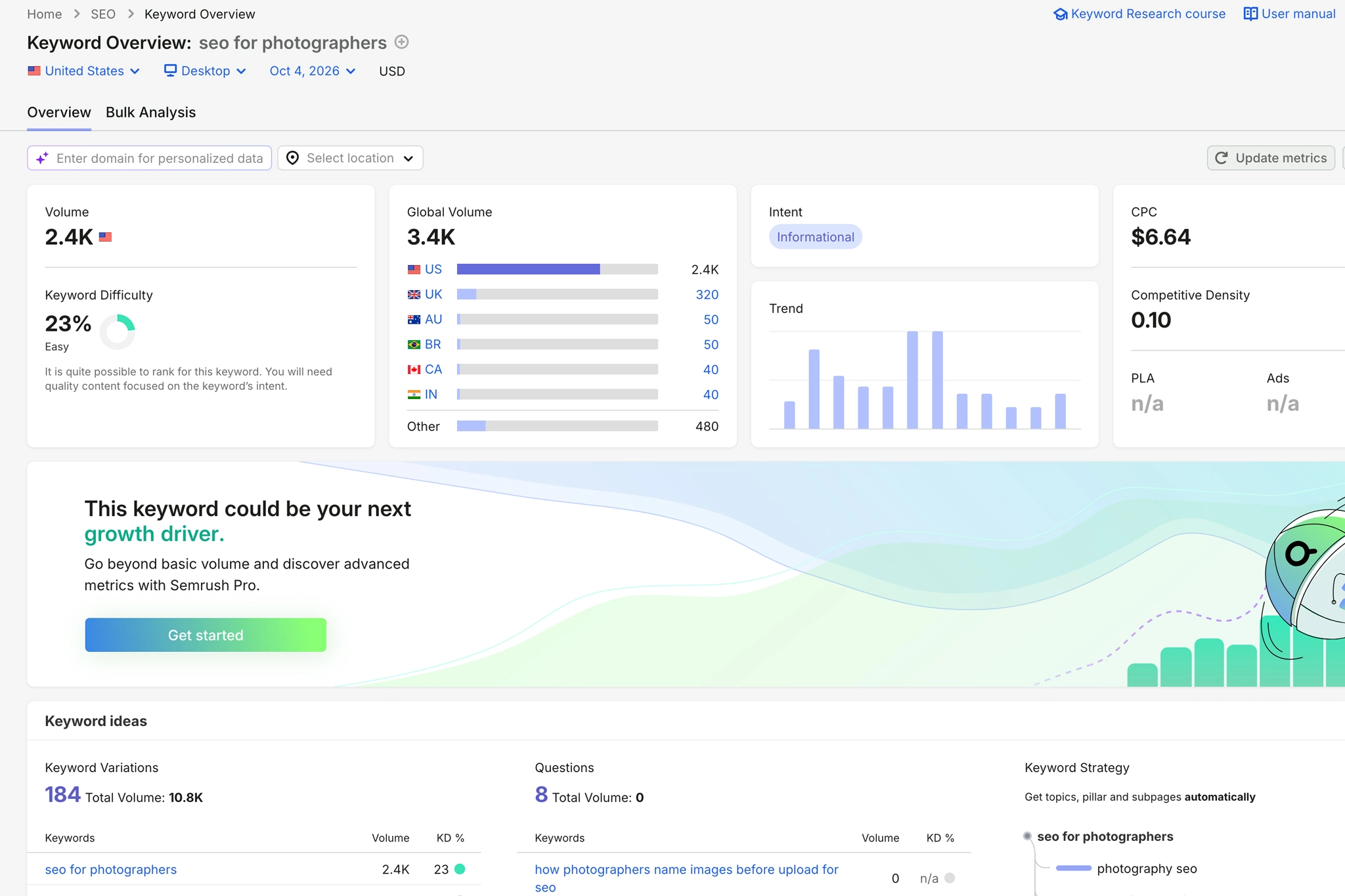
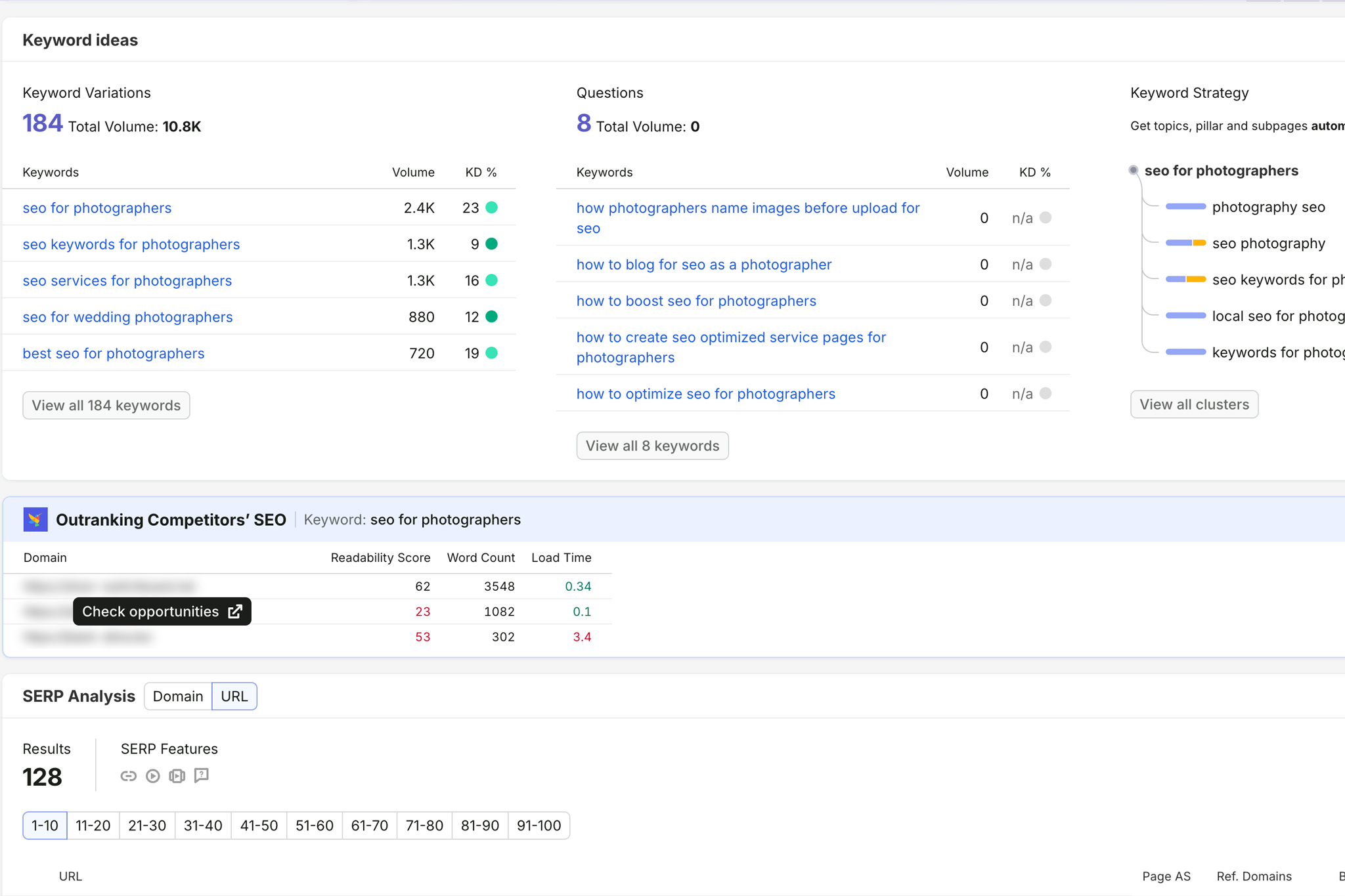
Before you look at search volume, evaluate these factors to decide whether a keyword is actually worth pursuing:
- Intent: What does the person actually want?
- Relevance: Does the keyword connect naturally with what you shoot or sell?
- Location: Does geography matter for this query?
- Page fit: Should the answer be a service page, portfolio, or blog post?
- Competition: Can your website realistically offer something strong enough to deserve visibility?
It’s important to answer the questions above because a broad keyword can generate a high number of impressions, but without building trust and authority, consequently little meaningful business follows. So avoid keywords without a precise context. The ultimate goal is not to win some kind of traffic trophy. It’s to attract targeted visitors whose problem you can actually solve, whether that means booking a photography service, finding a photo editing solution, or getting a valuable answer to whatever topic brought them to your site.
Finding the right keywords is only part of the equation. Your website also needs the structure, messaging, and internal connections to turn visibility into meaningful opportunities. Not sure where your photography website stands? Start with our free Photography Website Scorecard to identify what deserves your attention first.
SEO for Photographers Is Changing Because of AI Search
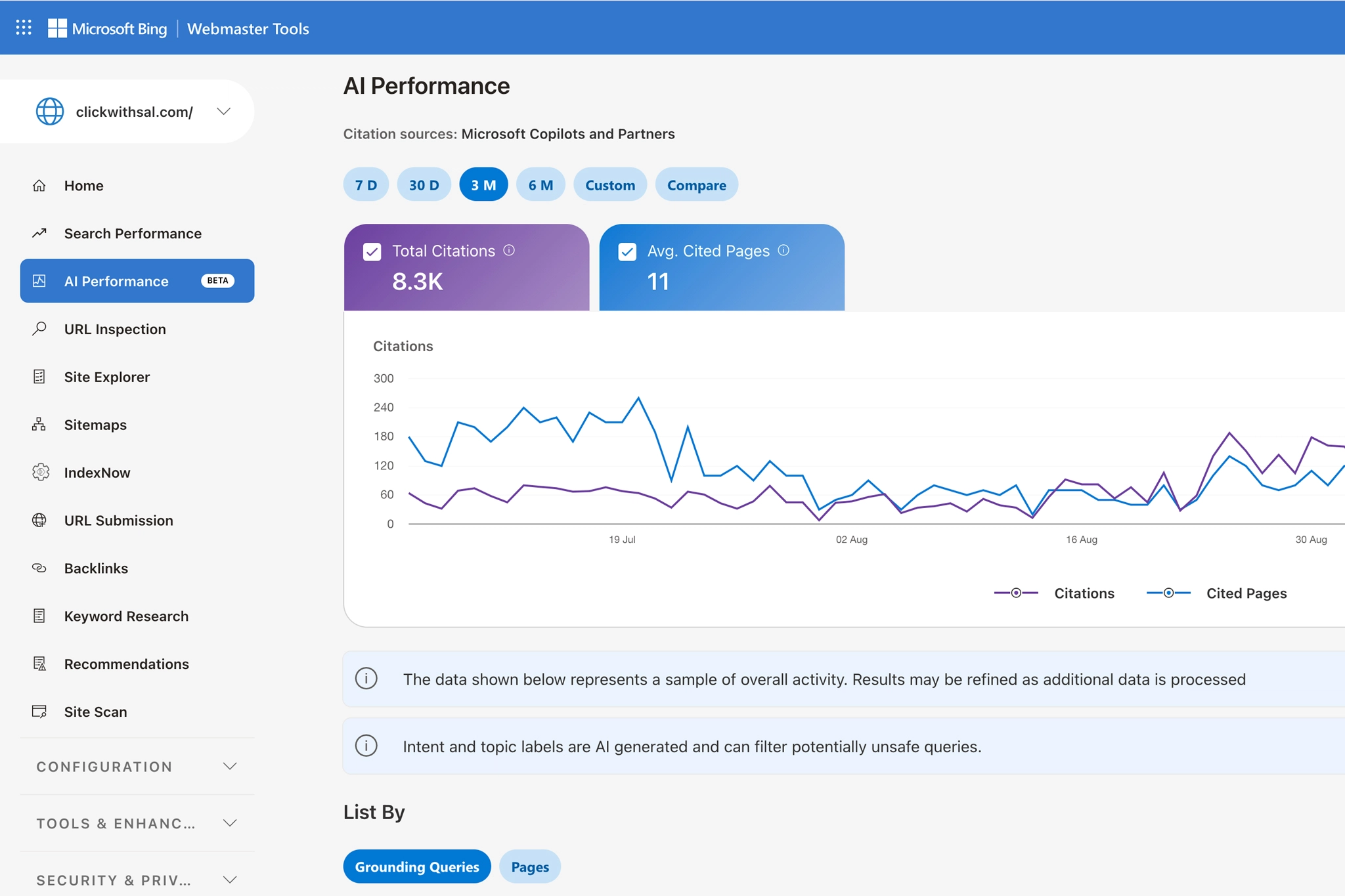
Search engines such as Google and Bing now surface AI-generated summaries and answers alongside traditional search results. But the fundamentals of SEO still matter. Pages need to be crawlable, indexable, useful, and strong enough to earn visibility in search before they have a realistic chance of surfacing in AI discovery.
At ClickwithSal, we monitor our publishing visibility across both conventional search and AI mentions, especially across Google, Bing, and DuckDuckGo. Across our photography content and resource pages, we have recorded meaningful AI citation activity. That matters because it shows that strong SEO can help photography content get discovered, understood, and cited long after publication. In other words, you do not need to rely on TikTok dances or similar nonsense, constant posting, or the hope that something randomly takes off on social media. If you are serious about building visibility around your photography, SEO deserves a place in your strategy. Over time, useful and connected content can build topical authority, which is where things start to get much more interesting.
None of this is guaranteed. We are simply sharing what has made a measurable difference for us. But we believe the opportunity is significant, especially compared with the endless social media cycle where thousands of creators compete for the same attention, often with weak targeting and content that disappears within days. The right place to start is by building enough useful, connected material around your real area of expertise that both visitors and search systems can clearly understand what your site is about. From there, consistency, credibility, and the quality of your actual work still matter. SEO can amplify authority, but it cannot manufacture it.
How to Build Topical Authority Without Publishing Junk

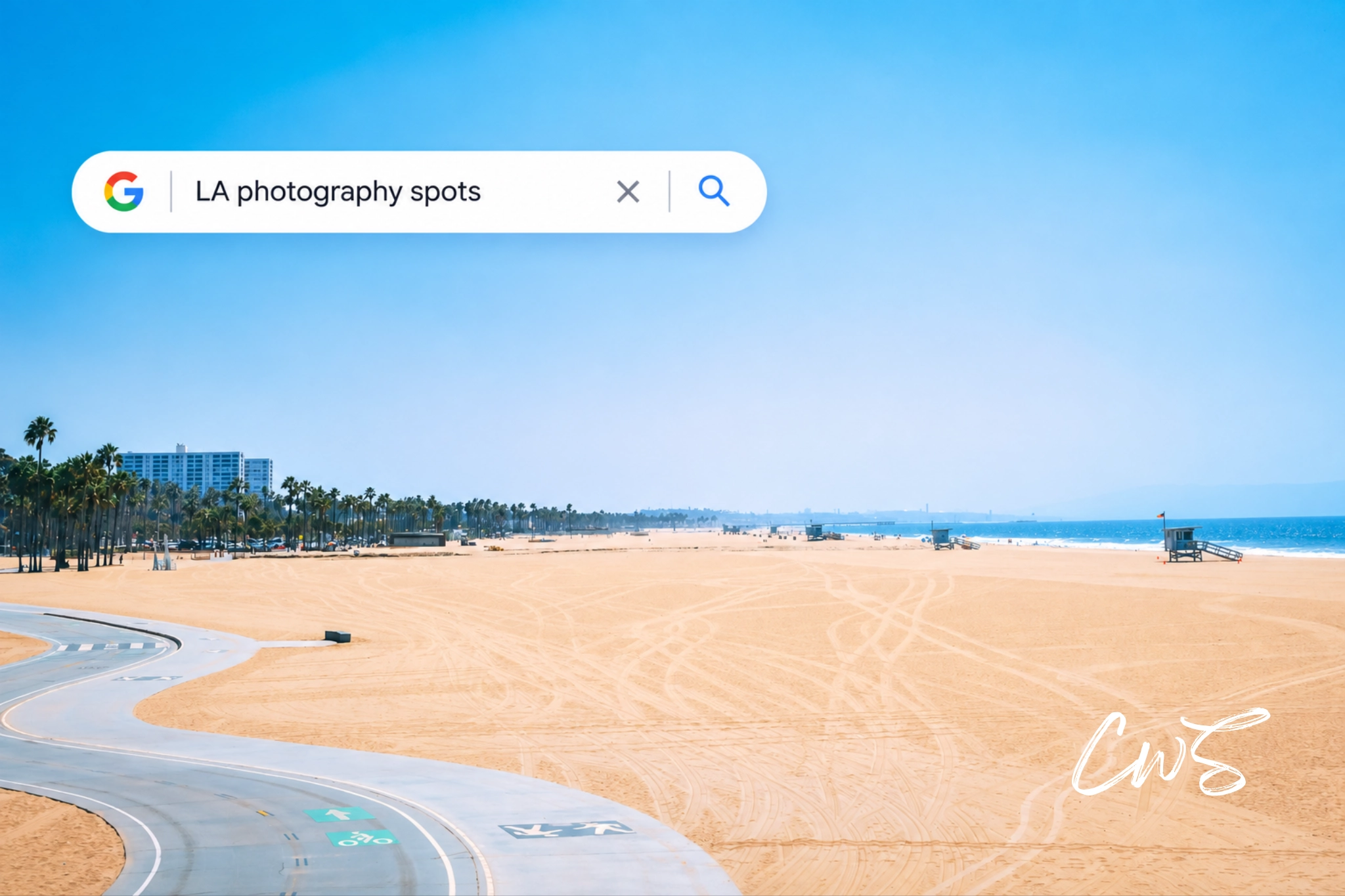
Imagine you are a photographer who publishes content about LA photography spots. Simply adding more pages or publishing more articles will not automatically build authority. A useful content cluster might look something like this:
- Best LA photography spots
- Best beach photography spots in Los Angeles
- Best places to photograph the LA skyline
- Best sunset photography locations in LA
- Street photography spots in Downtown LA
In this example, each supporting resource answers a legitimate search question while naturally pointing readers back toward your main LA photography spots guide. At the same time, you are building contextual internal links between related pages. Those connections help search engines understand how your content fits together, while making the overall site easier for both traditional search engines and AI-driven systems to interpret. Use your own photography as firsthand evidence whenever possible. For photography websites, that is one of your clearest advantages.
Finding the keyword is not usually the hardest part. Turning that idea into content worth publishing is. That is why we built The Photographer Blog Engine. It is a set of optimized ChatGPT prompts designed specifically around photography content. The point is not to press a button and flood your site with AI articles. That would defeat everything we just explained. The point is to give your real experience a repeatable publishing structure. If you want to test the approach first, our blog topics for photographers guide includes a free photoshoot-to-blog-post prompt. Use it on a real shoot. Your images and experience stay yours. The prompt handles the structure.

SEO Keywords for Photographers FAQs
The best SEO keywords for photographers match your specialty, audience, location when relevant, and the searcher’s intent. Examples include service keywords, pricing searches, client questions, and useful informational topics related to your photography business.
Start with the services, problems, and subjects most relevant to your photography business. Then evaluate search intent, relevance, competition, and the type of page that should answer the query. Search volume should support the decision, not control it.
Not necessarily. A lower-volume keyword with clear commercial or local intent can be far more valuable than a broad keyword attracting people who are unlikely to book, buy, or engage with your business.
Yes. Traditional SEO fundamentals such as useful content, crawlable pages, clear site structure, internal links, and topical relevance still help search engines understand your website. Those same signals can also support discovery in AI-generated search experiences.
Key Takeaways
- The best SEO keywords for photographers match search intent, business relevance, location, and the right page type, not simply the highest search volume
- Local service keywords and informational keywords serve different purposes and should usually lead to different types of pages
- Connected content, useful internal links, and firsthand photography can help build stronger topical authority over time
- AI search is expanding how photography content can be discovered, but strong SEO fundamentals still form the foundation
- SEO gives photographers a way to build lasting visibility beyond the constant cycle of social media posting














Leave a Reply